We are delighted to bring you a second article from Pauly. Pauly previously wrote a piece on the challenges of obtaining butter to compliment beautiful french bread, sampled on her travels through France.
Les Arcs – Provence
A few days after I had finalized the rental of the first two floors of a house in Les Arcs, I stopped in at the French Tourist Bureau in Rockefeller Center (New York City) and asked for any maps and brochures they had for Les Arcs. The clerk gathered up a large stack of material and put it into a manila envelope. I took a moment to see what they had given me. Pictures of the Alps and information on ski schools and ski equipment, etc. I went back and explained I was going to a town in Provence for the month of September. “Oh, that Les Arcs.” (officially, Les Arcs sur argens) That Les Arcs was a small town of about 5,000 and certainly not a tourist mecca. However, it was a stop on the train from Paris to Nice which made it very convenient for brief excursions, since I did not plan to rent a car. The express TGV (Train a Grande Vitesse) now stops in Les Arcs.

I should have been warned not to arrive on Sunday. All the taxi drivers were at “church.” I finally called my landlady; she didn’t drive but arranged for a neighbor to pick me up.
The house was in the old town (veille-ville ), an area of narrow, cobblestone streets at the highest point in the town, next door to the 11th-century chateau-fort. The area is full of arched doorways and vaulted passages. Most of the buildings have ancient stone walls and many have intricately carved doorways. The walk down to the center of the town was picturesque. It was not as delightful on the way up carrying groceries. The view was great.
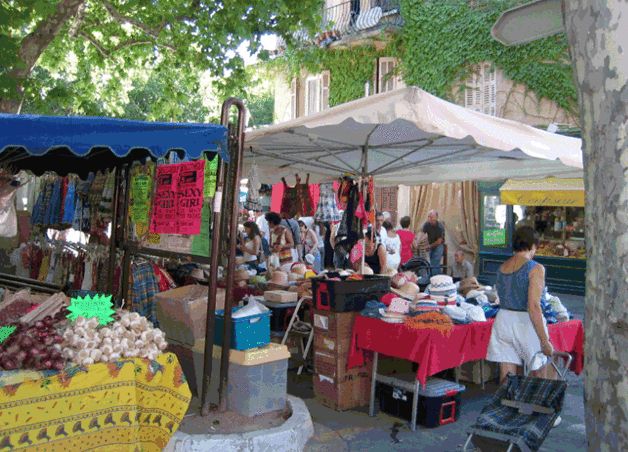
There was an outdoor market twice a week with fish, vegetables, etc. One man sold only garlic.
I was fortunate to be there when the grape harvest began (vendanges). Every few minutes a tiny tractor would zip through town hauling a cart piled high with grapes from the vineyards to the winery.
Draguignan
My first day trip from Les Arc was to the city of Draguignan, only a short bus trip of about seven miles. I studied the bus schedule. There was no pattern to the departure times. The bus ran whenever a train arrived from Paris or Nice at the Les Arc railroad station. The bus stop was at the town square in front of the large bandstand (Le Kiosque Offenbach). When I arrived, three others were waiting for the bus – two teenage girls and a woman about my age. One of the young girls was the first to board the bus. She cheerfully greeted the driver by name and kissed him on both cheeks. The second girl stepped aboard and did the same thing! For just a moment I felt panic. A local custom? Did one really kiss the driver? I was very relieved as the woman went next, deposited her fare and said good morning without kissing the driver! I swear he read my mind. He grinned as he said “Bonjour.”
Draguignan is a lively, pleasant city of about 30,000. I wandered in the morning then took a short cab ride to the American cemetery. I couldn’t stay long. It’s was so very painful.
The American Cemetery and the Memorial
The military cemetery Rhone in Draguignan is the home to more than one thousand graves of American soldiers who were killed in action, during operation Dragoon in 1944. They are buried, row upon row, under simple white crosses or Stars of David . Each marker is inscribed with the name, rank, unit, home state and date of death of the fallen. Some of the crosses read simply “Here Rests in Honored Glory an American Soldier Unknown but to God.”
The Rhone American Military Cemetery is the only military cemetery in Southern France and one of six WWII cemeteries located throughout France. More than 100,000 soldiers, sailors, airmen and Marines are buried in these cemeteries.
A veteran who returned for a ceremony writes,
“There are literally hundreds of memorials throughout France dedicated to Americans killed there in WW II and erected by an array of French people wanting to remember their legacy. I have witnessed the tears of older people who met some of us, American military personnel, for the very first time. Before they died, they wanted to simply say merci in person for the sacrifices of American troops who assisted in their rescue from Nazi tyranny. Their gratitude is extremely sincere and deep-rooted”.
